
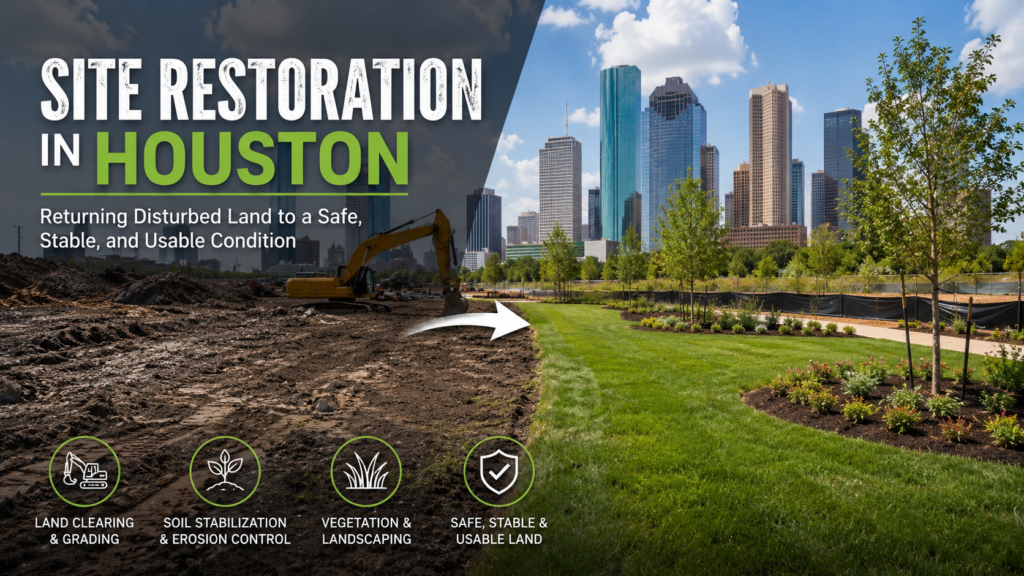
After a demolition, excavation, construction, or land clearing project is completed in Houston, the site itself is in a disturbed condition the natural landscape has been altered, soil has been exposed, and the surface no longer has the stability, drainage, or ecological function it needs. Site Restoration Houston is the process of bringing that disturbed land back to a defined standard of condition: safe for use, structurally stable, properly draining, and in many cases revegetated to prevent erosion and support ecological recovery.
What Is Site Restoration?
Site restoration encompasses the range of activities performed to return a disturbed site to a defined end condition after construction, demolition, or other disturbance activity. At its most basic, site restoration means grading, debris removal, and erosion control. At its most comprehensive, it includes engineered grading and drainage design, soil replacement and amendment, erosion protection systems, revegetation with native or specified plant species, and ongoing monitoring.
The appropriate scope depends on the nature and scale of the disturbance, the planned future use of the site, and regulatory requirements. A residential lot cleared for new construction requires relatively straightforward restoration: grading to established grades, erosion control during the construction period, and final grade restoration after the new structure is built. A former industrial site being converted to green space may require a much more comprehensive scope including soil remediation, engineered drainage, and multi-year revegetation programs.
Why Site Restoration Is Particularly Important in Houston
Houston’s rainfall intensity makes site restoration a high-priority activity. The region regularly experiences intense thunderstorm events hourly rainfall rates of 1 to 3 inches or more are not unusual that can cause severe erosion on unprotected, freshly disturbed soil surfaces. Harris County and the City of Houston have active stormwater quality enforcement programs that hold property owners and contractors accountable for sediment leaving their sites.
Houston’s expansive clay soils create settlement and stability concerns for restoration. Disturbed clay soils that are not properly regraded and compacted will settle unevenly over time, creating depressions that pond water, drainage issues that impact adjacent properties, and surface irregularities that make the site difficult or unsafe to use. Regulatory requirements also drive site restoration Harris County Flood Control District regulations, the City’s stormwater management rules, and TCEQ stormwater permit requirements all impose site restoration obligations on disturbed sites.
Core Components of Site Restoration in Houston
Debris removal is the first step. All construction waste, demolition debris, and material that does not belong in the finished site condition must be collected and removed. In Houston’s climate, debris left on site can quickly become entangled with vegetation regrowth, making subsequent removal more difficult and expensive.
Grading establishes the finished surface elevation and slope of the restored site. Proper grading in Houston creates positive drainage away from structures and toward appropriate drainage outlets the graded surface should not create any areas where water will pond. Standing water in Houston’s warm, humid climate quickly becomes a breeding ground for mosquitoes and a nuisance to adjacent property owners.
Erosion control protects the disturbed soil surface until vegetation can establish. In Houston, where rain events can be intense and frequent, erosion control is a regulatory requirement and a practical necessity. Common measures include silt fence along the site perimeter, temporary mulch application to protect exposed soil, erosion control blankets on slopes, and inlet protection structures to prevent sediment from entering storm drains.
Revegetation establishes the long-term biological protection of the restored site surface. In Houston’s warm climate, warm-season grasses establish quickly and provide effective erosion control and site stabilization. Hydroseeding the spray application of a mixture of seed, fertilizer, and mulch binder is a common and cost-effective revegetation method for larger disturbed areas. Native plant restoration is preferred for sites where ecological recovery is a priority.
Site Restoration for Houston’s Specific Development Contexts
Post-demolition lot restoration in Houston’s urban neighborhoods requires attention to the lot’s relationship with adjacent properties. A cleared lot that drains improperly can direct water onto neighboring parcels, creating drainage disputes and potential liability. Industrial site restoration in Houston’s petrochemical corridor involves additional considerations sites with known or suspected soil contamination require remediation as part of or prior to site restoration, with TCEQ’s remediation programs establishing the standards to which contaminated industrial sites must be restored.
Common Questions About Site Restoration in Houston
How long does site restoration take? A small residential demolition site might be restored in a single day. A large industrial or commercial site may require weeks of grading, erosion control installation, and revegetation work. Revegetation itself takes additional time seed germination and establishment may take weeks to months.
Is site restoration required by law in Houston? Yes, in most cases. Houston’s stormwater management regulations, TCEQ stormwater permit requirements for construction sites, and Harris County Flood Control requirements all impose site restoration obligations on disturbed sites. Non-compliance can result in fines, corrective action orders, and legal liability for downstream impacts.
What is the difference between site restoration and site remediation? Site restoration refers to the physical restoration of disturbed land grading, erosion control, revegetation. Site remediation refers specifically to the cleanup of contaminated soil or groundwater to meet regulatory standards. Contaminated sites often require both: remediation first, then restoration to re-establish a functional, stable land surface.